
DNA and Human Migration History
Beyond the last few centuries, DNA can say something about much older journeys. This is often called deep ancestry, and it works on a very different timescale from genealogy.
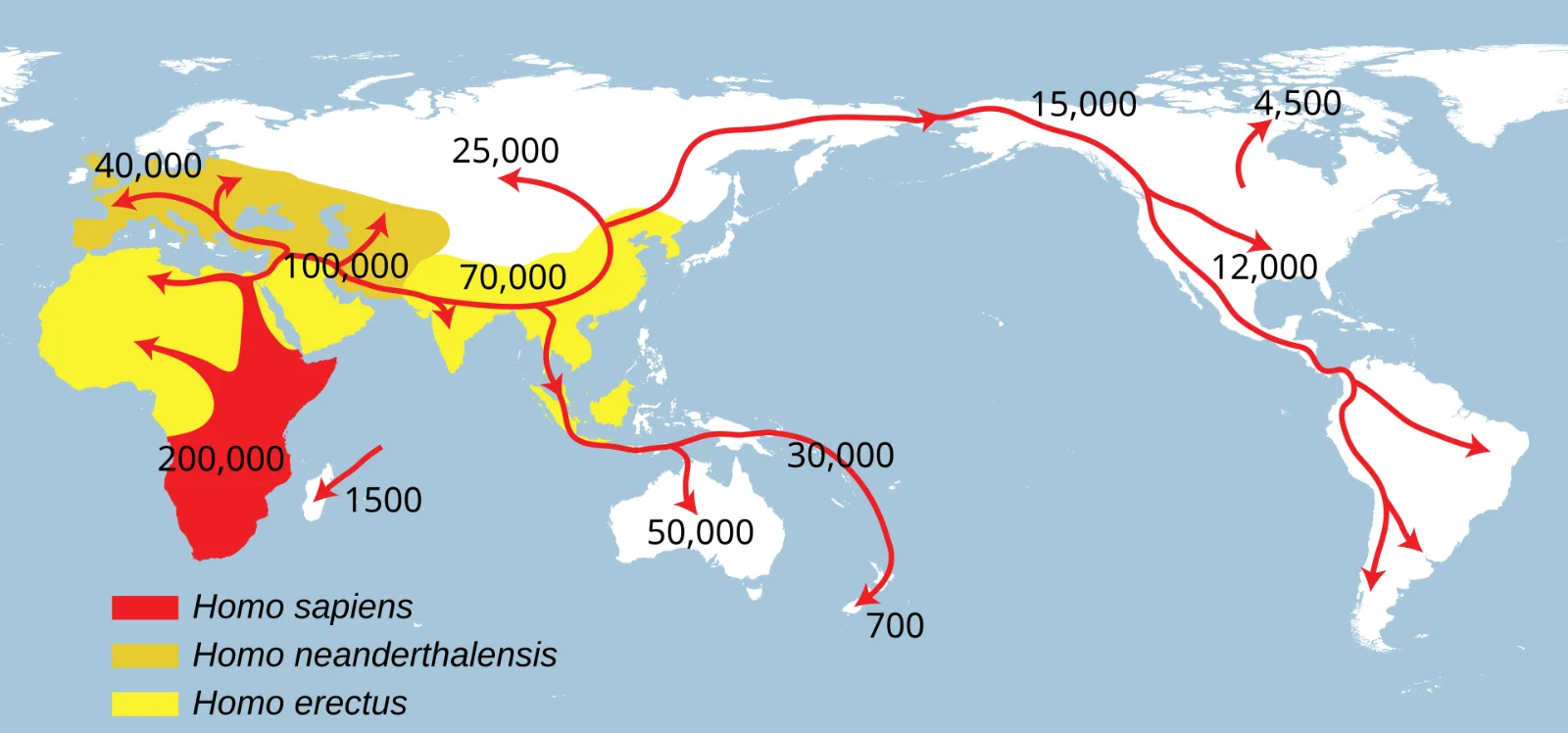
Out of Africa
The most widely accepted model of modern human origins holds that anatomically modern humans arose in Africa and later spread across the rest of the world, largely replacing earlier human populations. Genetic studies of living people have been among the main sources of evidence for this view.
Haplogroups as signposts
Because Y-DNA and mtDNA are passed down almost unchanged, the mutations they accumulate form a branching tree. Each branch, or haplogroup, can be associated with particular regions and time periods, so a tester’s haplogroup hints at the routes their direct paternal or maternal ancestors followed tens of thousands of years ago.
Popular interest
Books and projects brought deep ancestry to a wide audience. Bryan Sykes’s The Seven Daughters of Eve (2001) described major European mitochondrial haplogroups, and National Geographic’s Genographic Project, launched in 2005 with IBM and partners, invited the public to contribute samples to research on human migration.
Deep ancestry is not genealogy
- A haplogroup is shared by very large numbers of people and usually formed thousands of years ago.
- It describes one line out of thousands of ancestors.
- It does not identify a named ancestor or a specific place in recent history.
For recent family history, see interpreting your DNA results.